






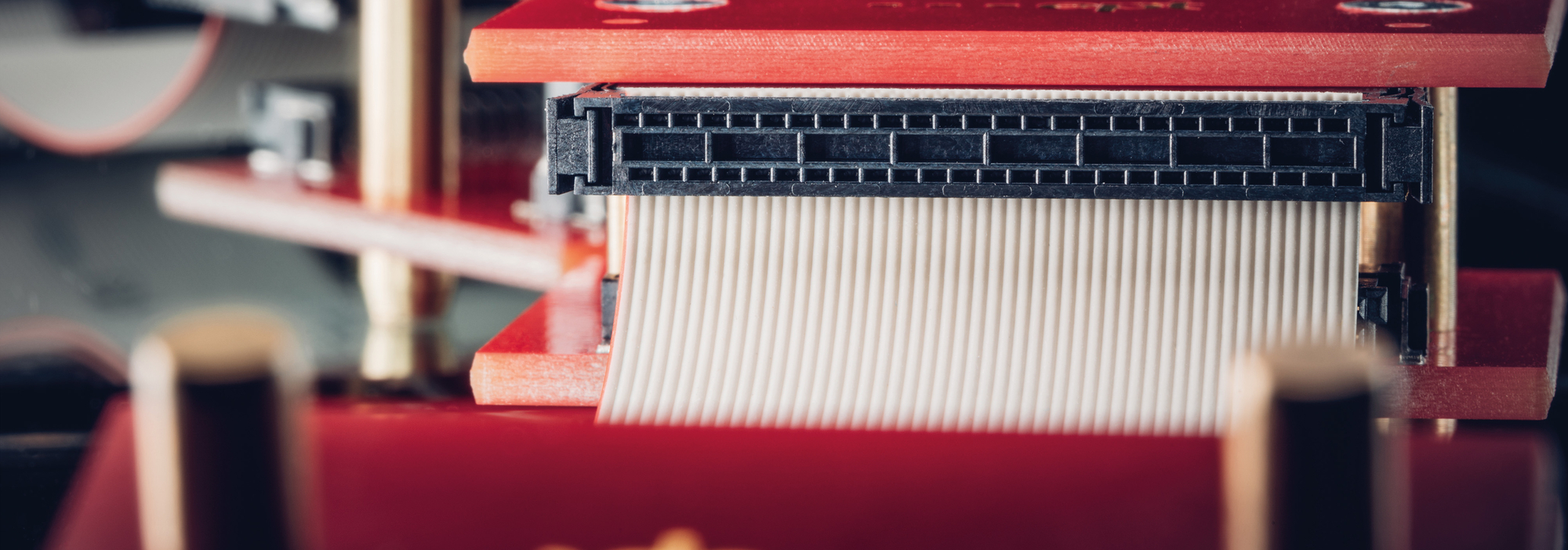
Power Converters in the Era of Technological Change
Smaller. More powerful. Smarter
New semiconductor materials, modular design concepts, and the integration of additional functionalities are driving the next stage of evolution in power converters.
Power converters are undergoing a transformation: new materials enable higher switching frequencies and more compact designs. These technological advances are driving progress in power converters (AC/DC and DC/DC converters) in particular—key components of modern applications such as e-mobility and renewable energy systems. As part of this development, innovative interconnection technologies are also gaining importance, enabling higher efficiency, miniaturization, and functionality.
In the following, we highlight the key technological developments in the field of power converters and demonstrate how these trends will have a lasting impact on the future of power electronics.
Power converters are undergoing a transformation: new materials enable higher switching frequencies and more compact designs. These technological advances are driving progress in power converters (AC/DC and DC/DC converters) in particular—key components of modern applications such as e-mobility and renewable energy systems. As part of this development, innovative interconnection technologies are also gaining importance, enabling higher efficiency, miniaturization, and functionality.
In the following, we highlight the key technological developments in the field of power converters and demonstrate how these trends will have a lasting impact on the future of power electronics.

Technological innovations are shaping modern power converters
Power Converters at the Heart of Modern Energy Supply

By regulating voltage levels and minimizing energy losses, power converters form the core of modern power supply systems. Growth opportunities in the power converter market stem from the rise of electric mobility, advancements in industrial automation, and the expansion of renewable energy systems. Current technological developments in power converters are focused on meeting the increasing demands for efficiency, miniaturization, and functionality.
New semiconductor technologies enable higher switching frequencies and more compact designs
The use of new semiconductor technologies such as silicon carbide (SiC) and gallium nitride (GaN) enables significantly higher switching frequencies, allowing for more compact and efficient designs with improved response times and control accuracy. Wide bandgap (WBG) semiconductors, such as SiC and GaN, have superior electrical properties in terms of switching speed, voltage withstand capability, and losses, thereby enabling more efficient operation at higher temperatures. By increasing the switching frequency, the weight and size of passive components, such as capacitors, can be reduced, allowing for more compact designs.
Miniaturization and increased efficiency
New circuit topologies and advances in manufacturing technology are leading to increasingly smaller power converters and placing high demands on thermal management and electrical layout, as high packing densities and shorter electrical traces are expected to reduce losses. The use of optimized heat sinks and insulated metal substrates (IMS) increases the reliability of power converters and improves heat dissipation. Advanced energy management functions enable dynamic adjustment of power consumption based on load requirements.
Modularization and standardization of assemblies
At the same time, modularization is becoming increasingly important. Standardized assemblies and modular systems allow modules to be flexibly configured, scaled, and more easily maintained, which shortens development times and reduces costs.
Intelligent systems with advanced functionalities
This progress is complemented by increasingly intelligent systems with advanced diagnostic and monitoring functions, digital control technologies, and the integration of advanced safety and protection features. The diagnostic and monitoring functions enable preventive maintenance and ensure better fault detection, while digital control technologies allow the performance of the converters to be optimized via software updates. Protection functions against overcurrent, overheating, and overvoltage ensure increased reliability and a longer service life for the power converters.
Supply chain challenges and component shortages
Despite technological advances, manufacturers of power converters continue to face challenges in the global supply chain. Shortages of key components—particularly power semiconductors, passive components, and control ICs—are leading to delays and rising costs. Modern wide-bandgap semiconductors such as SiC and GaN are particularly affected, as high demand and complex manufacturing processes limit their availability. To ensure supply, many companies are relying on strategies such as supplier diversification, regional manufacturing, and long-term partnerships.
Requirements for the joining technologies of tomorrow
The technological developments described in the field of power converters have a direct impact on the requirements for interconnect technology. The increasing demands for miniaturization, efficiency, and functionality are changing not only the layout of printed circuit boards but also the requirements for connectors and termination components. A key feature of modern power converters and modern connectors is their versatility and, consequently, their ability to adapt to the diverse requirements of various industries.
Less space, more functionality – demand for miniaturized connectors
The trend toward miniaturization is forcing developers to make the most of every millimeter, even when it comes to connection technology. On highly integrated printed circuit boards in particular, only limited space is available for connectors. This calls for compact yet high-performance connector systems that can transmit high currents and voltages despite their small form factor—while ensuring reliable electrical contact.
Higher loads require more robust solutions
Increasing electrical demands—such as higher switching frequencies or operating temperatures—also place greater mechanical and thermal stresses on connectors. Consequently, there is a growing need for robust, vibration-resistant, and temperature-resistant connection solutions that function reliably even under demanding operating conditions. Mechanical coding, latches, and optimized contact geometries help prevent misinsertion and contact issues.
Efficient design through modular connection solutions
Modular designs are becoming increasingly important in power electronics because they enable flexibility, scalability, and rapid adaptation. For connector technology, this means that connector systems must not only be reliable and high-performance, but also flexibly scalable, customizable, and service-friendly. These requirements can be met through a wide selection of pin counts and form factors, the option for custom configurations, and robust mechanisms for soldering and mating. As a result, modular connector systems play a crucial role in extending the service life of systems and reducing total cost of ownership.
Supply chain challenges and component shortages
The global component shortage is also having a significant impact on connection technology. Precious metals, specialized contact materials, and heat-resistant plastics are not only harder to come by but have also become significantly more expensive. The result is longer delivery times, higher material costs, and increased energy costs in the manufacturing process. To ensure supply security, factors such as close collaboration with suppliers, forward-looking planning, and flexible and adaptable design strategies are becoming increasingly important.
How modern connectors can meet these requirements
In addition to technological advancements and the design requirements for high-performance electronic systems, economic and strategic factors are increasingly coming into focus. Users and procurement professionals expect solutions that are technically sound and also sustainable in the long term in terms of availability, standardization, and cost.
High power density in a compact space
Flexibility thanks to a modular system
The modular system of the One27 product group offers a wide range of options for customizing connection solutions. A wide selection of designs, heights, and pin counts allows for continuous horizontal PCB spacing from 8.0 to 20.00 mm—achieved through a contact overlap of 2.4 mm. In addition to parallel (horizontal) connections, 90° and 180° configurations are also possible, offering high flexibility in PCB placement. In addition, cable connections enable flexible assembly layout, compensation for tolerances, and the implementation of custom spacing. The cables are available in various lengths and insulation types—depending on mechanical or thermal requirements. Furthermore, special configurations, such as partial assemblies or trailing contacts, can be implemented to specifically address specific electrical or mechanical requirements.

Durability for harsh environments
The One27 product family is characterized by its high robustness, which is particularly important for automotive applications. Mechanically, the One27 product family impresses with its high vibration resistance and stability, which are essential for automotive use. Even under demanding conditions, the electrical connection remains reliable. In addition, the One27 product family features practical mechanical characteristics such as anti-rotation protection for correct mating, positioning pins for precise placement, and insertion chamfers that compensate for angular and axial misalignment during mating. These features enhance ease of assembly and ensure a secure, precise, and durable connection.
Furthermore, the choice of insulation material is critical for temperature resistance. LCP (Liquid Crystal Polymer) is ideally suited for operating temperatures ranging from -55°C to +125°C due to its UL 94 V-0 flammability rating and meets the high requirements of the automotive industry.
Furthermore, the choice of insulation material is critical for temperature resistance. LCP (Liquid Crystal Polymer) is ideally suited for operating temperatures ranging from -55°C to +125°C due to its UL 94 V-0 flammability rating and meets the high requirements of the automotive industry.
Current-carrying capacity

Thanks to carefully selected materials and optimized contact geometry, the One27 product family can reliably transmit high currents without overheating or a drop in performance. The contact design, particularly the use of special copper alloys, ensures low contact resistance and efficient heat dissipation, maintaining a stable connection even under extreme operating conditions.
Current-carrying capacity is determined by the number of poles and current-carrying contacts; reduced hotspot formation inside connectors with fewer poles contributes to this performance.
Current-carrying capacity is determined by the number of poles and current-carrying contacts; reduced hotspot formation inside connectors with fewer poles contributes to this performance.
A reliable supply chain through regional production
Another key advantage of the One27 product line is that it is developed and manufactured within the European Union, ensuring a reliable supply chain with short lead times. This regional manufacturing ensures the highest quality standards while also guaranteeing the timely availability of components—a critical factor for manufacturers that rely on quick response times.
Conclusion and Outlook

Power converters are key components of modern energy supply—from electric mobility to renewable energy. Future developments will focus on higher power density, compact designs, improved efficiency, and greater system intelligence. New semiconductor materials such as SiC and GaN will significantly improve performance and thermal behavior.
At the same time, the demands on interconnect technology are increasing. Modular connectors must combine high electrical power and data communication within a compact, robust, and flexible system. The One27 system from ept ideally meets these requirements and is thus a decisive factor for the next generation of high-performance, future-proof converters. Interconnect technology is now a key driver of innovation and is no longer a side issue.
At the same time, the demands on interconnect technology are increasing. Modular connectors must combine high electrical power and data communication within a compact, robust, and flexible system. The One27 system from ept ideally meets these requirements and is thus a decisive factor for the next generation of high-performance, future-proof converters. Interconnect technology is now a key driver of innovation and is no longer a side issue.
Are you looking for a specific connector?
product list

For further information,
please contact us.
Submit an inquiry via the form
: +49 8861 2501 0
sales@ept.de
please contact us.
Submit an inquiry via the form
: +49 8861 2501 0
sales@ept.de